Mount Rainier National Park Camping Guide: Campgrounds, Reservations and Tips
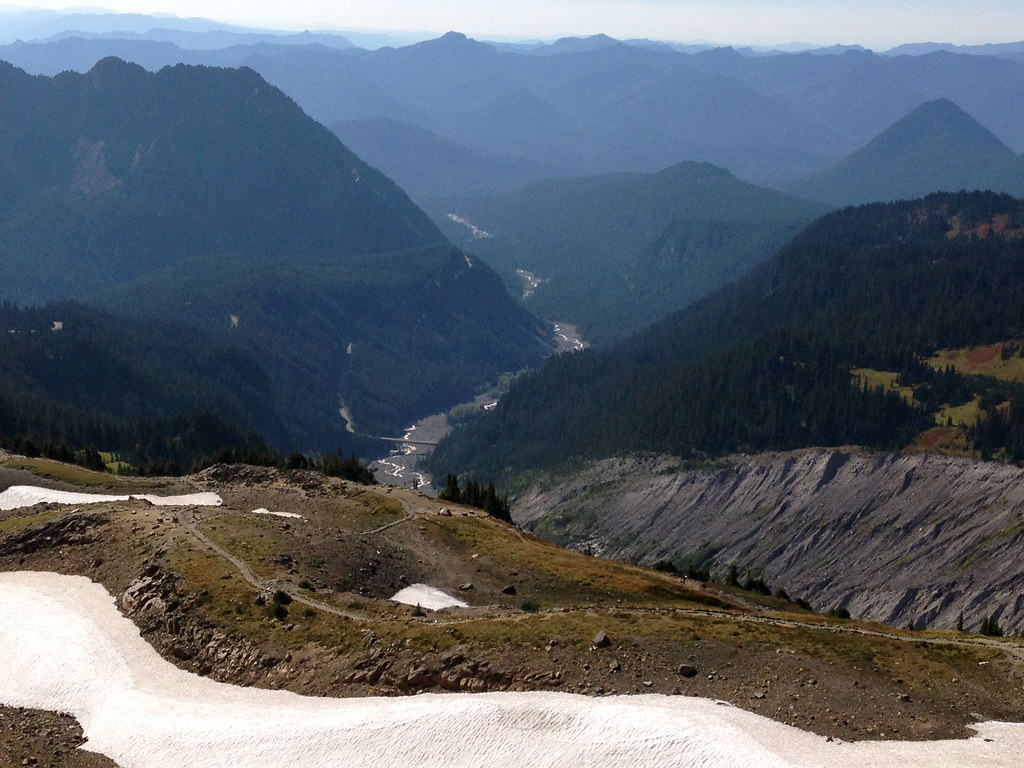
Photo: bdearth via Flickr (CC BY 2.0)
At Mount Rainier National Park, dawn at White River Campground arrives with glacial water muttering through the valley and cold air settling beneath Douglas firs. Above the trees, the upper slopes of 14,410-foot Mount Rainier catch sunlight while frost can still cling to picnic tables. The campground sits around 4,400 feet, so even an August morning may demand a warm layer before breakfast.
Camping inside the park reduces early morning driving and puts trailheads within reach before parking areas fill. The four established choices have sharply different characters: Cougar Rock serves the Paradise side, Ohanapecosh occupies a lower old-growth forest, White River provides access to Sunrise, and primitive Mowich Lake reaches the park’s quieter northwest corner. Our guide explains where each campground fits, what kinds of rigs and tents work there, and how to approach reservations.
Understanding Camping Areas in Mount Rainier National Park
Four campgrounds spread across separate road corridors
Mount Rainier’s roads do not form a quick loop around the mountain. Driving between campgrounds can require several hours, particularly when Stevens Canyon Road is unavailable or traffic builds near Paradise. Choose a campground according to the trails and landscapes you want to visit rather than treating every site as an interchangeable base. Cougar Rock and Ohanapecosh connect through the park’s southern road system, White River lies on the northeastern approach to Sunrise, and Mowich Lake sits at the end of an unpaved road from the northwest.
Elevation controls weather and camping season
Ohanapecosh, at roughly 1,900 feet, is generally the warmest and most sheltered campground. Cougar Rock sits near 3,200 feet in moist western forest, while White River and Mowich Lake occupy colder terrain around 4,400 and 4,900 feet. That elevation difference affects nighttime temperatures, snowmelt, mosquitoes, and opening dates. Snow can linger near Mowich Lake into early summer, while Ohanapecosh may be comfortable weeks earlier. Any campground can receive hard rain, and freezing nights are possible at the higher sites outside midsummer.
Mount Rainier National Park Campgrounds Compared
Settings, site styles, and vehicle limitations
None of the park campgrounds provides recreational vehicle hookups. Developed sites generally include a parking pad, tent area, picnic table, and food storage arrangement, but pad dimensions and level ground vary considerably. Larger motorhomes fit best at selected Cougar Rock or Ohanapecosh sites. White River has tighter roads and shorter spaces, while Mowich Lake is designed for tents and requires campers to carry equipment a short distance from the parking area.
| Campground | Approximate elevation | Best access | Site character | Typical vehicle fit |
|---|---|---|---|---|
| Cougar Rock | 3,180 feet | Paradise and Longmire | Forested developed sites with mixed privacy | Tents, trailers, and selected larger RVs |
| Ohanapecosh | 1,900 feet | Ohanapecosh River and southeast trails | Spacious old-growth setting with deep shade | Tents, trailers, and selected RVs |
| White River | 4,400 feet | Sunrise and northeast trailheads | Cool, rustic sites near a glacial river | Tents and smaller recreational vehicles |
| Mowich Lake | 4,900 feet | Spray Park and northwest backcountry | Primitive walk-in camping near the lake | Tents only |
Developed does not mean fully serviced
Campers should plan without electrical, water, or sewer hookups, and showers are not normally available inside the campgrounds. Seasonal potable water and restroom arrangements differ by location and operating period. Cellular coverage is weak or absent, especially at Ohanapecosh and Mowich Lake. Before departure, confirm current opening dates, fees, reservation rules, water availability, food storage requirements, road conditions, and any timed entry program on the official park site.
Choosing the Right Mount Rainier National Park Campground
Cougar Rock for Paradise and Longmire
Cougar Rock is the most practical base for the park’s heavily visited southwest side. Longmire, with historic buildings and access to the Trail of the Shadows, is about 2 miles away. Paradise lies roughly 10 winding road miles uphill and provides access to the 5.5-mile Skyline Trail loop, Myrtle Falls, and the meadows below the Nisqually Glacier. Sites sit among western hemlock, Douglas fir, and red cedar, creating shade and protection from wind but also holding moisture after rain.
Who should choose Cougar Rock
Our team recommends this campground for first-time visitors whose priorities include Paradise, wildflower meadows, and the historic southwest corridor. It also works well for mixed groups because short walks at Longmire can be combined with strenuous Paradise routes. Road noise and closely spaced sites reduce privacy in portions of the campground, so campers seeking solitude should study the site map before booking rather than selecting solely by pad length.
Ohanapecosh for old-growth forest and warmer nights
Ohanapecosh occupies the southeast corner of Mount Rainier National Park beside a clear, spring-fed river. The campground’s low elevation, enormous Douglas firs, and broad forest floor give it a different climate from Paradise or Sunrise. It is often warmer after sunset and less exposed to mountain wind. The 2.7-mile Silver Falls loop begins in the campground area and follows the river to a powerful cascade squeezed through dark volcanic rock.
Tradeoffs on the southeast side
Ohanapecosh is farther from unobstructed views of Mount Rainier, and reaching Paradise or Sunrise requires substantial mountain driving. It suits campers who value shade, river walks, and old-growth ecology over sunrise views from camp. The forest canopy can keep tent sites damp, so a footprint and careful rainfly ventilation matter. Campsites near the river may hear rushing water all night, while interior loops tend to feel quieter.
White River and Mowich Lake for trail-centered stays
White River places hikers near the road to Sunrise, the park’s highest developed visitor area at 6,400 feet. The Wonderland Trail crosses near the campground, and the Glacier Basin Trail begins nearby, climbing approximately 3.3 miles one way toward views of the Emmons Glacier. Mowich Lake is better for Spray Park, Tolmie Peak, and overnight backcountry itineraries. Its unpaved approach can be rough and dusty, and services are considerably more limited than at the developed campgrounds.
Mount Rainier National Park Camping Reservations and Arrival Tips
How reservable campgrounds usually operate
Cougar Rock and Ohanapecosh generally carry the park’s main reservable inventory through the federal recreation booking system. Campsites are commonly released on a rolling schedule several months before the arrival date, although operating seasons and release patterns can change. White River has traditionally operated on a first come, first served basis, while Mowich Lake uses a primitive arrangement with very limited capacity. A campground reservation covers the campsite, not every permit needed for separate backcountry travel.
A practical booking sequence
- Choose the road corridor first. Match Paradise trips with Cougar Rock, southeast forest walks with Ohanapecosh, Sunrise hikes with White River, and Spray Park plans with Mowich Lake.
- Check equipment dimensions. Measure the total length of the tow vehicle and trailer, not only the trailer body.
- Compare the site map with terrain. Look for parking pad length, tent limits, proximity to restrooms, and distance from main campground roads.
- Prepare backup dates. Midweek arrivals and dates outside peak wildflower season usually provide more options.
- Save confirmation details offline. Reception may disappear well before reaching the campground entrance.
First-Come, First-Served Camping in Mount Rainier National Park
Arrive early in the day and carry a backup plan outside the park, particularly for White River on summer weekends. Do not assume that an empty site is available because occupants may be hiking or because the site is held for an arriving camper. At primitive Mowich Lake, limited capacity and the long gravel approach make speculative late-evening arrivals risky. Food, drinking water, and fuel should be secured before entering that corridor.
Gear for Rain, Cold, and Volcanic Dust
Mount Rainier creates its own weather, and campground conditions can shift from warm afternoon sun to heavy rain overnight. Pack for a temperature range of at least 30 degrees Fahrenheit within a single day. Western campgrounds receive frequent moisture, while the exposed roads near White River and Mowich Lake generate fine volcanic dust during dry periods. Equipment should handle both conditions without relying on campground electricity.
Build a sleep system for cold ground
A three-season tent with a full rainfly is appropriate for most summer stays. Place a fitted footprint beneath it, keeping every edge under the tent floor so rain cannot collect between layers. An insulated sleeping pad with an R-value around 4 offers useful protection from cold ground at White River and Mowich Lake. A sleeping bag rated near 20 to 30 degrees Fahrenheit provides a sensible margin for higher-elevation nights, particularly in June and September.
Protect food and cooking equipment
Black bears, ravens, mice, and chipmunks quickly exploit unsecured food. Store groceries, scented toiletries, cooking utensils, trash, and pet food according to campground regulations whenever they are unattended. Never keep scented items inside a tent. Prepare meals on a stable stove rather than depending on a fire, since wet wood, seasonal restrictions, and smoky conditions can make campfires impractical.
| Item | Why it matters | Best choice |
|---|---|---|
| Rain shelter | Cooking in a tent creates fire and carbon monoxide hazards | Freestanding canopy secured for wind |
| Water containers | Water availability can be limited or seasonal | Several rigid containers filled before arrival |
| Lighting | Forest camps become dark well before open viewpoints | Headlamp plus spare batteries |
| Cooler | Food must remain contained and secured | Lockable hard-sided model |
| Footwear | Trails combine mud, roots, snow patches, and loose rock | Boots or trail shoes with aggressive tread |
What to Do Directly From Camp
Leaving the vehicle parked can save considerable time during busy mornings. Cougar Rock and Ohanapecosh provide immediate access to short forest walks, while White River and Mowich Lake connect directly with strenuous mountain routes. Carry the Ten Essentials even on familiar trails. Snow can obscure junctions above the campgrounds, and glacial streams often run higher late in the day.
Short outings from Cougar Rock and Ohanapecosh
From Cougar Rock, hikers can reach sections of the Wonderland Trail and explore the Nisqually River corridor without driving to Paradise. At Ohanapecosh, Silver Falls is the primary campground hike, while the Grove of the Patriarchs area lies nearby along the Ohanapecosh River corridor. Trail access in this flood-prone landscape can change after storms, so use posted closures as the controlling guidance rather than an older guidebook or downloaded route description.
High-country routes from White River and Mowich Lake
White River is a strong base for Glacier Basin and Burroughs Mountain itineraries, although the latter requires additional trail connections near Sunrise. From Mowich Lake, the Spray Park Trail climbs through forest to subalpine meadows below 10,188-foot Observation Rock. Tolmie Peak Lookout is reached from the lake area by a route of roughly 5.6 miles round trip, with views over Eunice Lake toward Rainier. Both areas involve sustained climbing and limited early-season shade above treeline.
Matching the Camping Season to Your Priorities
The practical camping season is compressed by snowpack. Lower Ohanapecosh usually becomes usable before the higher northern campgrounds, while Mowich Lake may retain snowbanks and muddy ground well into the early summer. July and August provide the broadest trail access, but they also bring the greatest competition for campsites, Paradise parking, and popular Sunrise trailheads.
Early summer brings water, snow, and insects
June into early July often delivers powerful waterfalls, full rivers, and snow-covered high trails. Microspikes may help on firm morning snow, but they do not replace route-finding skills or an ice axe on steep terrain. Mosquitoes emerge around wet meadows and Mowich Lake as snow recedes. Campers should pack repellent, a head net, and dry socks, then avoid trampling meadow edges while seeking snow-free ground.
Late summer and early fall require different preparation
August generally offers drier trails and widespread access, although wildfire smoke can reduce visibility and air quality. September brings colder nights, fewer insects, and changing vine maple and huckleberry foliage. Shorter daylight makes early starts essential for long hikes. Freezing temperatures become increasingly plausible at White River and Mowich Lake, and autumn storms can bring snow to high roads while rain continues at lower campgrounds.
Plan Your Mount Rainier National Park Camping Trip
A successful Mount Rainier National Park camping trip begins with geography. Choose Cougar Rock for Paradise, Ohanapecosh for old-growth forest, White River for Sunrise country, or Mowich Lake for a primitive trail-focused stay. Then match the campsite to the full length of your vehicle, carry enough water and fuel, and download maps and reservation records before cellular service disappears.
Build flexibility into each day. Mountain weather may favor a forest hike when high ridges are clouded, while a clear morning may justify an early trip to Paradise or Sunrise. With a rain-ready shelter, a cold-weather sleep system, secure food storage, and realistic driving plans, camp becomes an efficient base for exploring Rainier rather than another logistical challenge.
Want to keep exploring? Browse all our Mount Rainier guides and articles for more trip-planning tips and ideas.
Gear & Essentials
Tell us about your trip and we will add what else you will want:
The basics
Worth having in the car whatever the park.
For this trip
- Camp lantern Etekcity Camping Lanterns 4-Pack LED
- Camping hammock Wise Owl Outfitters Camping Hammock
- Camping pillow Hikenture Inflatable Camping Pillow
- Lighter & matches BIC Maxi Pocket Lighters 10-Pack
- Shelter tarp Amazon Basics Waterproof Multipurpose Camping Tarp
- Tent Camping Tent 2-4 Person Easy Setup
Traveling with kids
Bringing a pet
RVing
Backcountry
Winter conditions
On the water
Photography
Accessibility
As an Amazon Associate we earn from qualifying purchases, at no extra cost to you.