Yellowstone National Park: The Perfect Weekend Itinerary
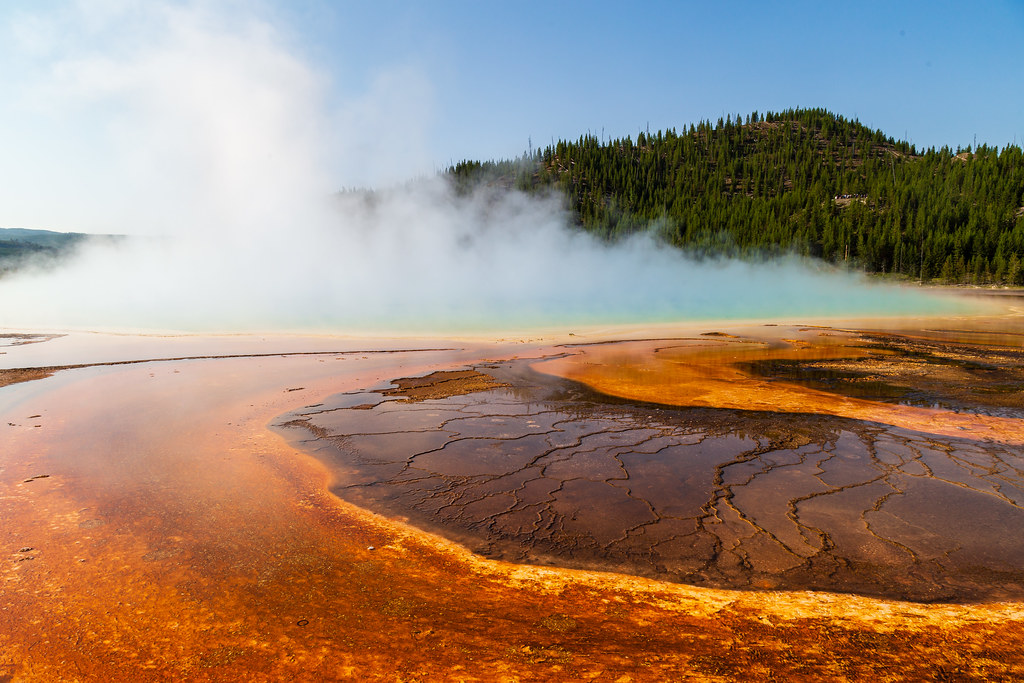
Photo: aparlette via Flickr (CC BY 2.0)
Our Yellowstone National Park Perfect Weekend route concentrates on the lower loop, where Old Faithful, Grand Prismatic Spring, Yellowstone Lake, Hayden Valley, and the Grand Canyon of the Yellowstone fit into two demanding but realistic days. The park covers more than 2.2 million acres, and its five entrances feed a road system shaped roughly like a figure eight. Trying to include every basin, valley, and waterfall usually produces a weekend spent watching scenery through a windshield.
This itinerary assumes arrival on Friday evening, two full sightseeing days, and lodging near West Yellowstone or inside the western and central portions of the park. It prioritizes Yellowstone’s volcanic landscape on Saturday, then wildlife and canyon scenery on Sunday. Drive times below exclude wildlife jams, roadwork, parking searches, and bison standing in the road, all common reasons a 30-minute segment can take twice as long.
Route Logic for the Perfect Yellowstone National Park Weekend Itinerary
Use the lower loop as the backbone
Yellowstone’s lower loop connects Madison, Old Faithful, West Thumb, Lake Village, Canyon Village, and Norris. The circuit covers roughly 96 miles before adding side roads, overlooks, or the drive to your lodging. It contains the park’s strongest concentration of hydrothermal features and provides access to Hayden Valley, one of the most reliable roadside wildlife areas.
Driving the loop clockwise on Saturday places Old Faithful and the Upper Geyser Basin early, before parking pressure builds. Sunday’s route approaches Hayden Valley near dawn, when cooler temperatures and lighter traffic improve the odds of seeing bison, elk, coyotes, and occasionally bears or wolves. The sequence also avoids retracing long sections of road.
Choose one gateway and stay consistent
West Yellowstone is the most practical gateway for this plan because the West Entrance reaches Madison Junction in about 14 miles. Gardiner works better for travelers prioritizing Mammoth Hot Springs and Lamar Valley, while Jackson requires a long approach through Grand Teton National Park. Cody adds the scenic East Entrance corridor but increases driving substantially.
Inside the park, lodging around Old Faithful, Grant Village, Lake Village, or Canyon Village can shorten the route. Availability is limited and often fills well ahead of summer weekends. Changing hotels after one night usually costs more time than it saves, especially when morning wildlife traffic slows check-out and departure.
Separate essential stops from optional detours
- Essential: Upper Geyser Basin, Grand Prismatic Spring, Hayden Valley, Grand Canyon of the Yellowstone, and at least one Yellowstone Lake viewpoint.
- Optional: Fountain Paint Pot, Firehole Canyon Drive, Mud Volcano, West Thumb Geyser Basin, and Artist Paintpots.
- Save for another trip: Lamar Valley, Mammoth Hot Springs, Tower Fall, and the full Norris Geyser Basin circuit unless your lodging or entrance makes them convenient.
Yellowstone National Park: The Perfect Weekend at a Glance
Two-day driving plan
| Day | Main stops | Primary highlight | Approximate driving |
|---|---|---|---|
| Friday | Gateway town to Madison area | Orientation and early check-in | 30 to 60 minutes |
| Saturday | Old Faithful, Upper Geyser Basin, Grand Prismatic Spring | Geysers and hot springs | 2 to 3 hours, excluding stops |
| Sunday | Hayden Valley, Yellowstone Lake, Canyon area | Wildlife, waterfalls, and canyon geology | 3 to 4 hours, excluding stops |
Why mileage understates the commitment
Yellowstone roads generally have low speed limits, narrow shoulders, and frequent animal crossings. A single bison herd can stop traffic in both directions, while popular parking areas may require several slow circuits before a space opens. Our team plans around time blocks rather than mileage and leaves at least one unscheduled hour each afternoon.
Cell service is absent across substantial parts of the lower loop. Download offline maps before entering, photograph your lodging address, and carry a paper park map. Navigation apps can estimate unrealistic speeds or suggest seasonally closed roads, particularly during spring and autumn transitions.
Friday Arrival and Essential Logistics
Enter before dark when possible
Friday evening should be used for positioning rather than major sightseeing. Enter through the West Entrance, continue beside the Madison River, and watch for elk and bison in the broad meadows before Madison Junction. Twilight increases animal activity, but it also makes dark-coated bison difficult to see against the pavement. Reduce speed well before sunset.
If daylight remains, stop at the short boardwalks around Terrace Springs or visit the Firehole River corridor without committing to a long hike. Save Old Faithful for the morning, when eruption viewing and basin walking fit together efficiently. Visitors arriving from another gateway should aim to sleep near their first Saturday stop rather than crossing the entire park after dark.
Fuel, food, and current operations
Fill the tank in your gateway community and start with breakfast supplies, water, and a packed lunch. Fuel and food are available in several developed park areas, but relying on them can add queues and restrict when you leave a wildlife sighting. Store all food securely and never leave coolers unattended at picnic areas.
Entrance fees, lodging operations, road openings, construction, and seasonal services can change. Confirm current details on the official park site before departure, especially in April, May, October, and November. Spring openings depend on snow removal, and major storms can delay scheduled access, as occurred during the April 2026 Yellowstone road opening.
Saturday Morning on the Perfect Yellowstone National Park Route
Begin at Old Faithful and the Upper Geyser Basin
Reach Old Faithful early and check the posted eruption prediction before walking farther into the basin. Old Faithful’s intervals vary, so build the morning around the current prediction rather than assuming an eruption occurs on the hour. While waiting, walk portions of the Upper Geyser Basin, which contains the world’s densest concentration of active geysers.
The most efficient basin walk
Follow the boardwalk past Old Faithful toward Castle Geyser, then continue toward Grand Geyser if time and prediction windows align. A longer route can reach Morning Glory Pool near the end of the paved basin path. The out-and-back walk to Morning Glory is about 3 miles, while shorter loops around Geyser Hill provide fumaroles, hot springs, and smaller geysers with less time on foot.
Continue to Grand Prismatic Spring
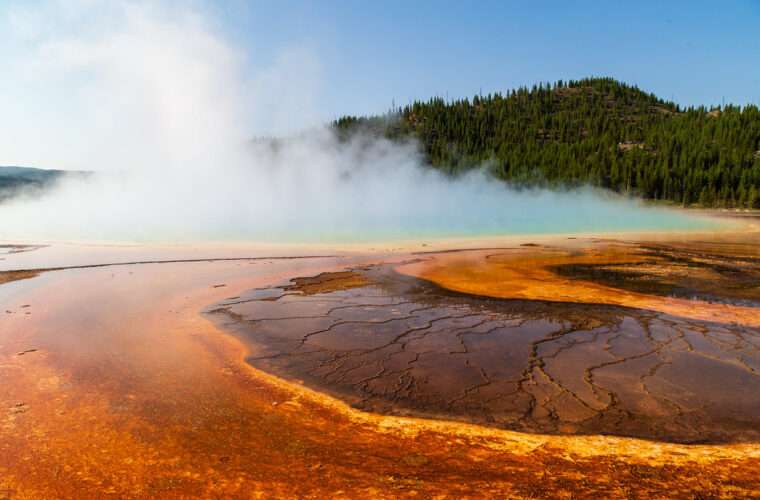
Drive north to the Midway Geyser Basin for the boardwalk beside Grand Prismatic Spring, a hot spring approximately 370 feet across. Its blue center and orange microbial mats reflect sharp temperature differences across the water. Steam can obscure the color on cold mornings, so the elevated overlook reached from the Fairy Falls trailhead often produces a clearer overall view later in the day.
On the overlook climb, packed gravel gives way to a steady rise above lodgepole pine forest. The air can feel cool under the trees, then warmer where sunlight reaches the exposed slope. At the platform, the spring suddenly appears as a broad blue oval ringed in yellow and rust, with steam sliding across the Firehole River valley below. The overlook route is about 1.6 miles round trip and includes roughly 100 feet of elevation gain.
Finish Saturday Along the Firehole River
Choose one final thermal stop
After Grand Prismatic Spring, use Fountain Paint Pot as the afternoon stop if energy and parking permit. Its half mile boardwalk passes all four major hydrothermal feature types found in Yellowstone: hot springs, geysers, fumaroles, and mudpots. The mudpots become thicker and more forceful as summer evaporation reduces their water content. Allow about 45 minutes, then continue toward Madison Junction rather than adding the larger Norris Geyser Basin.
Protect the evening buffer
Return to West Yellowstone from Madison Junction in roughly 30 minutes under normal conditions. Travelers staying around Old Faithful or Grant Village should reverse direction and avoid crossing the park solely for dinner. Use the remaining daylight to refuel, prepare Sunday’s lunch, and organize binoculars and warm layers. Sunday begins before sunrise, and searching through luggage in a dark parking area wastes the quietest wildlife viewing period.
Sunday on the Perfect Yellowstone National Park Itinerary: Hayden Valley to the Grand Canyon
Reach Hayden Valley around first light
Hayden Valley lies between Canyon Village and Yellowstone Lake along the Yellowstone River. Visitors based in West Yellowstone should allow close to two hours for the predawn drive through Madison, Norris, and Canyon, while lodging near Canyon shortens the approach considerably. Stop only in established pullouts. Bison routinely occupy the roadway, and bears or wolves can create sudden traffic backups near Grizzly Overlook and the northern valley pullouts.
Use binoculars before moving the vehicle
Scan open slopes, willow edges, and distant carcass sites before changing locations. Bison and elk are readily visible without magnification, but wolves often appear as small moving shapes far across the valley. Maintain at least 100 yards from bears and wolves and 25 yards from other wildlife. A roadside crowd never makes it safe to approach an animal or stop in a traffic lane.
Pause at Yellowstone Lake
Drive south through the valley to Fishing Bridge and the northern shore of Yellowstone Lake, which sits at approximately 7,733 feet. The lake covers about 136 square miles and remains cold throughout summer, with sudden wind capable of building rough water quickly. A shoreline stop near Lake Village provides the needed scale without consuming the morning. Add West Thumb only if at least 90 minutes remain available for the drive, parking, and boardwalk.
End at the canyon rims
Return north to the Grand Canyon of the Yellowstone and begin at Artist Point on the South Rim. Lower Falls drops 308 feet into a canyon colored by hydrothermally altered volcanic rock. For a closer view, use the North Rim overlooks or descend the steep Brink of the Lower Falls Trail. That short trail loses roughly 600 feet, making the climb back demanding at an elevation near 8,000 feet.
- Must stop: Artist Point for the classic Lower Falls and canyon view.
- If time permits: Upper Falls Viewpoint or Lookout Point on the North Rim.
- Skip when tired: Brink trails, which add steep climbing late in the weekend.
- Exit west: Continue through Norris and Madison rather than returning through Hayden Valley.
Adjust the Route for Weather and Season
Match the schedule to daylight and road access
The Yellowstone National Park Perfect plan works most smoothly from late June through September, when the lower loop is generally open and daylight supports early starts. Snow can linger around Canyon and Yellowstone Lake well into spring. Afternoon thunderstorms are common during summer, particularly over the higher plateaus, so complete exposed overlooks and longer boardwalk walks before dark clouds begin building.
| Season | Likely conditions | Best adjustment |
|---|---|---|
| Late spring | Snowbanks, cold mornings, changing road access | Keep thermal basins central and carry traction for icy paths |
| Summer | Full access, heavy traffic, afternoon storms | Enter before sunrise and eat lunch away from major hubs |
| Early autumn | Cold nights, lighter crowds, possible snow | Add insulated layers and finish long drives before dark |
| Winter | Most park roads closed to ordinary vehicles | Replace this driving circuit with authorized snowcoach or snowmobile access |
Pack for elevation rather than the gateway forecast
Old Faithful sits around 7,300 feet, Canyon Village near 7,900 feet, and several road segments climb higher. Temperatures can vary sharply between a sunny geyser basin and a shaded canyon rim. Carry a waterproof shell, insulating layer, sun protection, at least two liters of water per person, and footwear with reliable grip. Bear spray should remain accessible on trails, never buried in a backpack or left in a hot vehicle.
Complete the Perfect Yellowstone National Park Weekend Without Overloading It
A successful Yellowstone weekend depends on disciplined choices. Saturday belongs to the Upper and Midway geyser basins, while Sunday combines Hayden Valley, Yellowstone Lake, and the canyon. That division follows the lower loop’s geography and preserves meaningful time outside the vehicle. Optional stops should fill genuine schedule openings rather than displace Old Faithful predictions, dawn wildlife viewing, or the canyon rims.
Leave with a full fuel tank, offline navigation, packed meals, and one hour of flexibility each day. Those simple preparations absorb wildlife jams and crowded parking without unraveling the route. Mammoth Hot Springs, Lamar Valley, and Norris Geyser Basin deserve a future visit, giving this focused weekend a clear finish instead of an exhausting final detour.
Want to keep exploring? Browse all our Yellowstone guides and articles for more trip-planning tips and ideas.
Gear & Essentials
Tell us about your trip and we will add what else you will want:
The basics
Worth having in the car whatever the park.
For this trip
Traveling with kids
Bringing a pet
RVing
Backcountry
Winter conditions
On the water
Photography
Accessibility
As an Amazon Associate we earn from qualifying purchases, at no extra cost to you.