Yellowstone National Park in Summer: What to Expect and What to Do
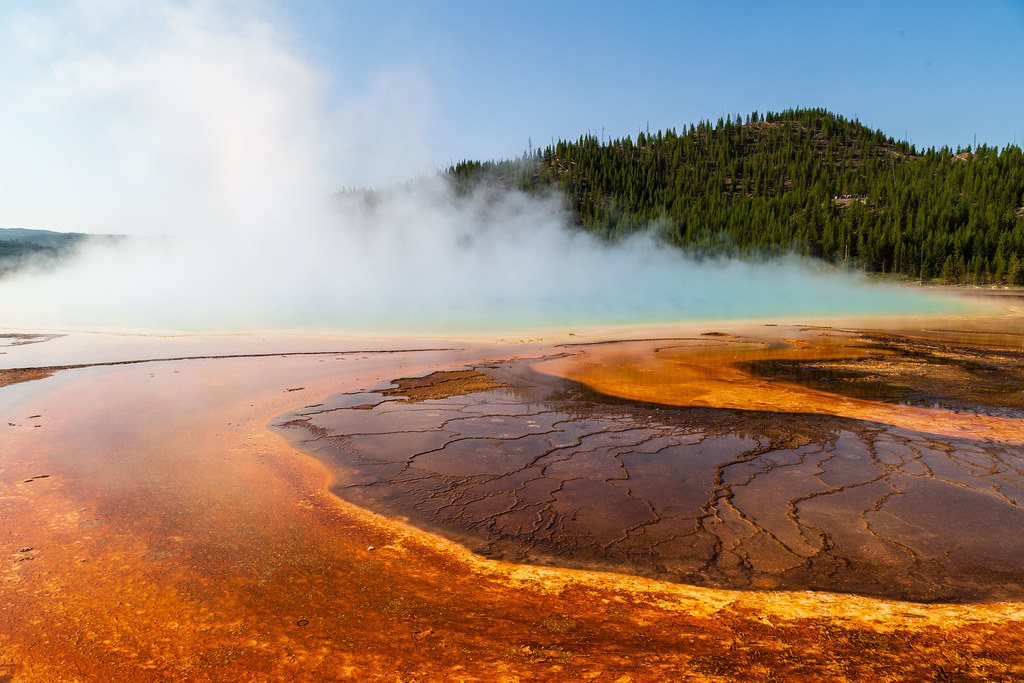
Photo: aparlette via Flickr (CC BY 2.0)
A Yellowstone National Park summer morning at Grand Prismatic Spring begins with cool air, steam drifting across the boardwalk, and the smell of sulfur rising from the Midway Geyser Basin. At this hour, the turquoise center appears and disappears behind moving vapor. By midday, the same boardwalk can feel warm, exposed, and crowded, with traffic backing up along the Grand Loop Road.
Summer provides the broadest road access, the longest hiking days, and the widest choice of ranger programs, wildlife watching, and geothermal sightseeing. It also brings highly variable weather and the park’s heaviest visitation. Our guide breaks the season into practical travel windows, explains how crowds affect a day on the ground, and covers the access and reservation decisions that should be made before arriving.
Yellowstone National Park in Summer at a Glance
A vast park connected by a figure eight road
Yellowstone covers about 2.2 million acres across Wyoming, Montana, and Idaho. Its Grand Loop Road forms a roughly 142-mile figure eight connecting Old Faithful, Yellowstone Lake, Canyon Village, Mammoth Hot Springs, Norris Geyser Basin, and the wildlife valleys. Five entrances feed into this system, but distances from the gates to major sights are substantial. Driving from the West Entrance to Old Faithful usually takes about an hour before delays, while Mammoth Hot Springs and Yellowstone Lake occupy opposite ends of a much larger touring circuit.
Elevation shapes every summer day. Mammoth Hot Springs sits near 6,200 feet, Yellowstone Lake at 7,733 feet, and Dunraven Pass at approximately 8,859 feet. Visitors can leave a mild gateway town and encounter cold wind, hail, or lingering snow at higher trailheads. Mobile service remains limited across much of the interior, so our team recommends downloading maps and saving reservation information before entering the park.
Why summer changes the range of possible trips
By the core summer period, the Grand Loop and connecting entrance roads are generally open to regular vehicles, creating access to trailheads that remain snowbound or unreachable during winter. Summer also makes multi-region itineraries practical. A traveler can watch bison in Hayden Valley, hike the South Rim of the Grand Canyon of the Yellowstone, and reach Yellowstone Lake within the same portion of the park, though trying to cover every basin in one day leads to excessive driving.
Choosing the Best Time to Visit Yellowstone National Park in Summer
Summer conditions develop gradually rather than arriving on a fixed date. June often retains characteristics of spring, July brings the most reliable high-country access, and August tends to be warmer and drier. Snowpack, wildfire activity, road construction, and animal movement can alter the experience from year to year, but the following comparison captures the usual pattern.
| Travel period | Typical conditions | Crowd pattern | Access and activities |
|---|---|---|---|
| Late May to mid-June | Cold mornings, rain, mud, and possible snow at elevation | Moderate, increasing toward mid-June | Major roads generally accessible, some trails remain wet or snow-covered |
| Mid-June to early July | Long daylight, green valleys, frequent afternoon storms | Heavy around geyser basins and canyon overlooks | Improving trail access, strong waterfall flows, active wildlife |
| July | Warm afternoons, cool nights, sudden thunderstorms | Usually the busiest period | Broad road and trail access, boating and longer hikes become practical |
| August | Drier landscapes, chilly dawns, possible smoke | Heavy early in the month, easing later | Good high-country hiking, lower waterfall volume, shifting wildlife activity |
| Early September | Cold nights, shorter days, possible early snow | Lower after the holiday period | Most summer touring remains possible, with fewer family groups |
June for waterfalls, calves, and long evenings
June often delivers the greenest landscapes and strongest water flow. The Yellowstone River surges over the 308-foot Lower Falls, while snowmelt feeds cascades throughout the canyon country. Bison calves are conspicuous in Lamar and Hayden valleys, and elk often occupy lower meadows near Mammoth. Mosquitoes can be numerous near wetlands, and trails such as Mount Washburn may retain deep snow or muddy sections well after lower boardwalks have dried.
July for the widest trail access
July is generally the safest choice for visitors prioritizing long hikes and predictable road access. Trails around Yellowstone Lake, the Canyon area, and higher passes are more likely to be free of persistent snow. It is also the period when parking pressure becomes most disruptive. Old Faithful has extensive parking, but Norris Geyser Basin, Grand Prismatic Spring, and popular waterfall overlooks can fill early and generate roadside queues.
August for warmer hiking and quieter late-season mornings
August suits travelers who prefer drier trails and can tolerate colder dawns later in the month. Meadows begin losing their vivid green color, and wildfire smoke from Yellowstone or distant regions may reduce visibility. Wildlife viewing remains productive, particularly around sunrise, although many animals rest in shade during warm afternoons. Water levels decline, changing the character of smaller waterfalls and thermal runoff channels.
Weather, Daylight, and Seasonal Ecology
Temperatures can change sharply within hours
Typical summer afternoons often reach the 70s Fahrenheit at lower elevations, while nights can fall into the 30s. Freezing temperatures remain possible, especially around Yellowstone Lake and exposed plateaus. Thunderstorms build quickly and may produce lightning, gusty wind, hail, and abrupt temperature drops. Open ridges, including the Mount Washburn area, require an early start because hikers have limited shelter once clouds begin building.
A useful day pack should address both sun exposure and cold precipitation. Yellowstone’s elevation increases ultraviolet exposure, while geothermal basins offer little shade. We carry:
- A waterproof shell and an insulating layer
- At least two liters of water for moderate hikes
- Sun protection, including sunglasses and sunscreen
- Bear spray in an accessible holster, not inside a backpack
- A paper map or downloaded offline map
- Insect repellent for wetlands and forested lake margins
Wildlife follows temperature and food
Bison commonly use the open grasslands of Lamar and Hayden valleys, sometimes stopping traffic as entire groups cross the road. Elk gather around Mammoth and other meadow systems. Grizzly and black bears may feed near forest edges, avalanche paths, and berry-producing slopes, but sightings become less predictable as summer advances. Visitors must use pullouts rather than stopping in a traffic lane and should maintain the park’s required wildlife distances.
Road Access, Crowds, and Advance Planning
Congestion changes how much ground you can cover
A distance of 30 miles can consume well over an hour when bison occupy the roadway, construction controls alternate traffic, or parking queues form near thermal basins. Old Faithful, Grand Prismatic Spring, Norris, Artist Point, and the entrances to Hayden Valley experience recurring pressure from late morning through afternoon. Starting before 8 a.m. helps, but sunrise wildlife watchers already occupy many Lamar and Hayden Valley pullouts.
Build each day around one geographic area rather than crossing the entire park repeatedly. Pair Old Faithful with the Upper, Midway, and Lower geyser basins. Combine Canyon Village with Hayden Valley and the north or south rim overlooks. Group Mammoth Hot Springs with the northern range. This approach reduces backtracking and leaves room for animal jams, short walks, and unscheduled geyser eruptions.
Yellowstone National Park Summer Reservations and Permits
In-park lodging and reservable campgrounds can fill many months ahead, especially for July. Gateway communities provide alternatives, but daily driving distances increase considerably. Backcountry camping requires a permit, and fishing requires a Yellowstone permit under park-specific regulations. Vehicle entrance policies, reservation release dates, campground operations, permit windows, fees, and road projects can change, so confirm current details on the official park site before booking.
A practical booking sequence
- Choose one or two park regions as priorities before selecting lodging.
- Reserve lodging or camping as soon as inventory opens for the intended dates.
- Apply for required backcountry access during the applicable advance window.
- Check road construction and seasonal opening information before finalizing daily routes.
- Recheck conditions shortly before departure, particularly after a snowy spring.
Late snowstorms can postpone road openings and interrupt spring preparation, as illustrated by our report on a Yellowstone road opening delayed by a winter storm. By summer, the concern usually shifts from winter closure to construction delays, wildlife jams, and temporary restrictions associated with fire or damaged infrastructure.
How Summer Compares With the Rest of Yellowstone’s Year
Summer is the only practical choice for travelers who want to combine the full Grand Loop Road with high-elevation hiking, lake activities, and multiple park regions in one visit. Spring and autumn provide lighter visitation but carry greater uncertainty around snow, freezing temperatures, and seasonal services. Winter requires an entirely different plan because most interior roads close to regular vehicles and access shifts to commercially operated snowcoaches and snowmobiles.
| Season | Crowds | Weather | Road and trail access | Best suited to |
|---|---|---|---|---|
| Spring | Light to moderate | Cold, muddy, and changeable | Roads open in stages, many trails retain snow | Waterfalls, newborn wildlife, lower-elevation touring |
| Summer | Heavy | Mild afternoons, cold nights, thunderstorms | Broadest road and trail access | First visits, hiking, camping, complete road tours |
| Autumn | Moderate, then light | Cold mornings and possible snow | Good early, followed by gradual seasonal closures | Elk rut, photography, quieter scenic drives |
| Winter | Low outside concentrated tour areas | Severe cold and deep snow | Most interior roads closed to ordinary vehicles | Snow travel, wolves, geothermal landscapes |
Spring favors flexibility
April and May expose the park’s seasonal transition. Bears emerge, bison calves begin appearing, and the northern road between Gardiner, Mammoth, and Cooke City usually provides the most dependable vehicle corridor. Elsewhere, staged road openings determine what can be reached. Boardwalks may be clear while nearby forest trails remain buried or waterlogged, making spring better for wildlife observers than travelers committed to specific high-country hikes.
Autumn and winter require narrower goals
September brings bugling elk around Mammoth and Madison Junction, while golden aspens brighten portions of the northern range. Snow can interrupt travel before formal seasonal road closures begin. Winter concentrates visitors along the plowed northern road or on authorized oversnow trips into the interior. Anyone comparing these seasons with a Yellowstone National Park Summer trip should decide whether broad access or lower visitation matters more.
Choosing Activities That Fit a Summer Day
Yellowstone’s geothermal features, canyon rims, and wildlife valleys operate on different natural schedules. Thermal basins photograph best when enough sunlight reaches their colored microbial mats, although cold mornings produce heavier steam. Wildlife activity generally peaks near dawn and dusk. Exposed trails are most comfortable before afternoon heat and thunderstorms develop. A productive itinerary assigns each part of the day to the landscape most likely to reward it.
Geothermal walks and canyon viewpoints
The Upper Geyser Basin contains Old Faithful and miles of boardwalk connecting features such as Castle Geyser, Grand Geyser, and Morning Glory Pool. At Canyon, the Brink of the Lower Falls Trail descends sharply toward the lip of the waterfall. Near the bottom, the pavement feels steep underfoot, the roar fills the narrow rock corridor, and cold spray reaches the railing as the Yellowstone River drops into the canyon.
Short hikes with meaningful scenery
Mystic Falls can be reached on a roughly 2.4-mile round trip from Biscuit Basin, leading through lodgepole forest to a 70-foot cascade on the Little Firehole River. The Grand Prismatic Overlook is approached from the Fairy Falls trailhead and provides the elevated perspective needed to see the spring’s complete color pattern. Both routes have limited shade, and the packed trail surfaces can become hot during July afternoons.
A Decision Framework for Planning the Trip
Start with the experience that would make the visit feel complete, then accept the tradeoffs attached to it. Long hikes point toward July or August. Powerful waterfalls, green valleys, and young animals favor June. Travelers sensitive to dense crowds should consider the final portion of August or early September, recognizing that smoke, frost, and shorter daylight become increasingly possible.
Choose by priority
- First visit: Allow at least three full days and divide them among the geyser basins, canyon country, and northern range.
- Wildlife: Stay close enough to Lamar or Hayden Valley to reach a pullout before sunrise.
- Hiking: Select lodging by trail region rather than by the nearest entrance gate.
- Photography: Build spare mornings into the schedule for fog, steam, smoke, and animal movement.
- Families: Alternate boardwalks with picnic stops and short overlooks to limit time in the vehicle.
Leave space for Yellowstone’s delays
A rigid schedule fails when a geyser erupts later than expected, a bison herd blocks the road, or lightning closes an exposed trail. Keep one major objective and two nearby alternatives for each day. Maintain at least 100 yards from bears and wolves and 25 yards from other large wildlife. Thermal crust can be dangerously thin, so every geyser basin visit must remain on designated boardwalks and trails.
Planning a Better Yellowstone National Park Summer Visit
The strongest summer plans match geography, daylight, and seasonal conditions. Reserve the hardest lodging component first, organize days by neighboring regions, and place wildlife viewing and exposed hikes during cooler hours. Carry layers even when the forecast appears mild, and expect road congestion to reduce the number of stops that fit into a day.
June rewards visitors with runoff and active valleys, July provides the broadest hiking access, and August often brings drier trails with a growing chance of smoke and cold mornings. Choosing among those tradeoffs matters more than creating a long checklist. Yellowstone works best when the schedule leaves enough room to wait for an eruption, watch a herd cross the valley, or change course when weather reaches the plateau.
Want to keep exploring? Browse all our Yellowstone guides and articles for more trip-planning tips and ideas.
Gear & Essentials
Tell us about your trip and we will add what else you will want:
The basics
Worth having in the car whatever the park.
For this trip
Traveling with kids
Bringing a pet
RVing
Backcountry
On the water
Photography
Accessibility
As an Amazon Associate we earn from qualifying purchases, at no extra cost to you.